

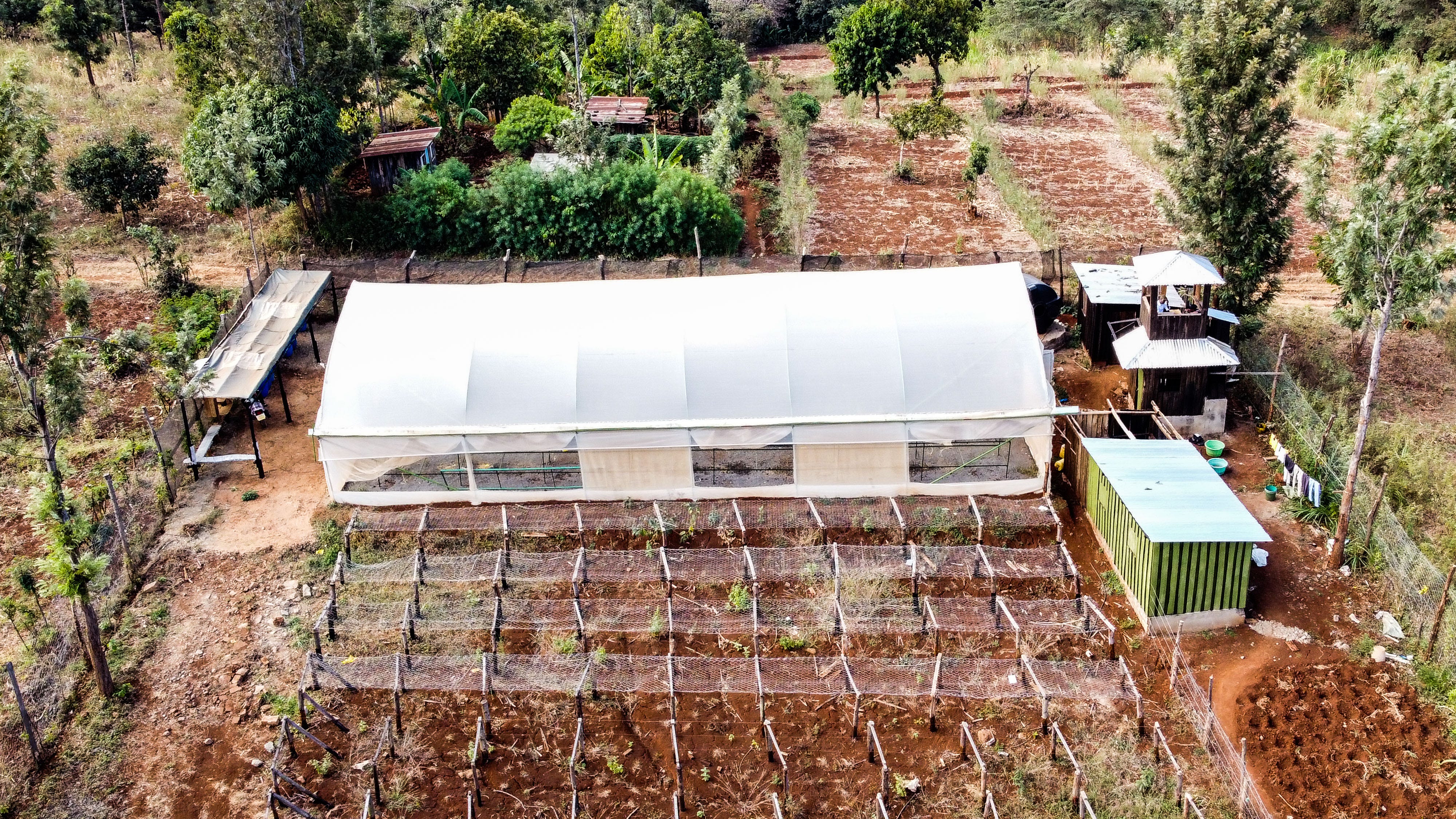
In Meru County, Kenya, I visited a women-led coffee producer organization where one member had donated part of her land for a solar-powered drying bed. Women sit on the cooperative board, while an all-women team of university graduates works across agronomy, post-harvest production, administration, market promotion, and export facilitation.
What stayed with me was the contrast with the deep gender disparity that still characterizes coffee production. Women account for roughly 70% of the labor behind coffee production, yet their economic position often does not reflect the work they do. In Kenya, fewer than 10% of women own land individually, while globally women operate less than 30% of coffee farms.
This disparity sits within a supply chain in which roughly 80% of the world’s coffee is produced by smallholders. Whether it reaches us as a seven-dollar pour-over at a specialty café, a bag we brew at home, or a three-in-one sachet on the go, much of that coffee begins in farming households where the labor behind production does not necessarily translate into equivalent control over land, income, or decision-making.
A closer look at that disparity reveals a series of structural barriers. Land ownership can determine access to credit and the ability to invest in seedlings, inputs, or irrigation. Cooperative membership can affect access to seedlings, agronomy support, finance, market information, and payments. Registration determines who appears in the supply chain as the producer, while leadership determines who has a voice when producer organizations make decisions.
The phrase “women-grown coffee” can therefore hide as much as it reveals. A woman may own and manage her farm, cultivate coffee on household land registered to her husband, work as unpaid family labor, or earn wages as a seasonal picker. These are very different economic relationships. A serious sourcing approach therefore has to ask who owns or controls the productive asset, who is registered as the producer, who receives payment, who belongs to the cooperative, and who participates in decisions.
A coffee importer in Brussels or a roaster in Seattle cannot resolve land-tenure inequality or rewrite inheritance practices in a producing country. But buyers do decide which producer organizations receive contracts, how much coffee they purchase, whether relationships continue over several seasons, and whether social commitments influence supplier selection.
The good news is that solutions already exist at origin, although they have emerged in different ways. Some have been strengthened through development programs. In Kenya, for example, We Effect, a Swedish Development Organization, worked within coffee cooperatives to address women’s limited access to land, seedlings, training, savings mechanisms, and positions within cooperative structures. In Nandi County, the Kahawa na Mama initiative has brought the issue into the household itself, with participating groups using joint registration of coffee bushes between spouses as one way to give women a recognized stake in the crop they help produce.
Similar approaches are emerging elsewhere in East Africa. In Uganda, the EU-funded MARKUP II program, implemented by the International Trade Center in partnership with the East African Community, has introduced a Gender Household Approach within coffee-growing communities. Rather than treating the farm automatically as an enterprise belonging to the male household head, the approach works with couples on shared planning, decision-making and responsibility for the coffee garden. Through ITC’s SheTrades work, that household approach also extends into the business systems surrounding the coffee. Coffee enterprises are being supported to examine women’s participation as suppliers, workers and decision-makers; at Elgon Coffee Enterprises, this has included improving supplier records, digitizing coffee-quality information and using delivery documentation that encourages acknowledgment by both spouses.
That connection between the household and the commercial is a necessary recipe for gender equity in coffee production. Attitude change may matter within the family. Still, it becomes more consequential when it affects who is recognized as a supplier, who is associated with a delivery, and who becomes visible to the enterprise buying the coffee. Registration and recordkeeping are therefore not neutral administrative details. They can help determine whether women’s contribution remains informal or begins to acquire recognition within the commercial system itself.
Uganda also provides a more direct example of interventions around land. In Kanungu, Farm Africa worked with coffee farmers and cooperatives to introduce voluntary household land-use agreements through which women could gain recognized control over portions of household land for coffee production. This was combined with Village Savings and Loan Associations, links to financial institutions, and the Gender Action Learning System, which brings women and male household decision-makers together around questions of labor, income, and household planning. The program therefore did not approach women’s economic participation through training alone; it connected access to land, finance, decision-making, and cooperative participation.
In Ethiopia, TechnoServe’s Climate Resilience through Empowering Women program, supported by Global Affairs Canada and Nespresso, takes the institutional argument further along the coffee chain. Operating in Sidama and Oromia, the program works simultaneously with coffee-growing households, wet mills and the wider industry. Women receive farm-management and climate-resilience training alongside leadership support intended to increase their influence within coffee-growing households and communities. At the wet-mill level, the program combines quality, governance and environmental improvements with leadership and management training for women, recognizing that greater participation in production has limited effect. Women remain absent from the institutions that control processing, quality, and commercial decision-making.
Other initiatives have emerged through women’s own organizing. The producer organization I visited in Meru, UGIMA, is one such example. Social entrepreneur Martin founded it after leaving the NGO sector to find a more self-sustaining model for social change, using coffee production as a vehicle for that transformation. His work began with a small group of women producers. Still, it gradually expanded through community dialogue and advocacy, including engagement with families and men to create opportunities for wives, daughters, and sisters to establish their own coffee production.
Today, the organization operates through two connected structures: a cooperative that forms the producer base, with more than 90% women members, and a separate social-enterprise arm that markets and facilitates coffee exports.
The cooperative does more than aggregate production. It supplies farmers with inputs and provides practical support on regenerative agriculture, including shade management, soil-moisture conservation using farm residues, composting with livestock manure and coffee husks, and intercropping with crops that improve soil health while providing additional household income. Its coffee clinic tests seedlings and supports grafting before distributing planting material to farmers, alongside lower-chemical approaches such as molasses-based traps for pest control. Women are represented on the cooperative board, while the all-women team of university graduates I encountered works across agronomy, post-harvest production, administration, market promotion and export facilitation. What began as collective organizing has therefore developed into a producer institution in which women participate not only as coffee growers, but across production, governance, technical services and market access.
Whether externally supported or self-organized, these initiatives show that the first mile has plenty of solutions. What many producer groups need is not another program designed for them, but reliable commercial partners willing to buy their coffee and build longer-term trading relationships.
The practical question for a specialty importer in Seattle, Melbourne or Brussels is therefore not necessarily, “What gender program should we introduce?” It is: who is already doing this work at origin, and can we build a commercial relationship with them?
Some companies are already approaching sourcing this way. Girls Who Grind Coffee in the UK sources 100% of its coffee from women producers, but its model goes beyond the “women-grown” label. The company emphasizes larger purchases, repeat relationships, and traceability rather than building its sourcing around isolated high-scoring microlots. In practice, that means returning to the same producers over time and treating women growers as long-term commercial partners rather than as the story behind an occasional specialty lot.
Similarly, Kahawa 1893 was founded in the United States by a Kenyan entrepreneur with the idea of building a stronger commercial connection between East African coffee producers and the consumers buying their coffee abroad. The company sources from farming partners in Kenya, Rwanda, and Congo, with a strong focus on women producers, but its model goes beyond sourcing alone. It also brings the consumer directly into the economic relationship through a tipping platform linked to its packaging, allowing customers to send additional payments to farming partners. Kahawa 1893 matches those contributions dollar for dollar. According to the company, these funds have supported investments such as equipment and livestock, creating an additional flow of capital alongside the coffee purchase itself.
The models differ, but the principle is the same: gender-responsive sourcing becomes part of the commercial relationship itself—who the coffee is purchased from, how much is purchased, whether that relationship continues, and how economic value reaches producers—rather than being added afterward as a marketing story. We need more companies at destination willing to build their sourcing around that principle: more Kahawa 1893s, more Girls Who Grind Coffees, and more buyers prepared to make women’s economic participation part of how they choose and sustain supplier relationships.
But we also need more origin initiatives that don't have to wait for a development program to arrive. This brings me back to Meru. Martin began with a small group of women farmers and spent years working not only with them, but with their families and communities, persuading farmers to create space for wives, daughters, and other women relatives to own or control productive land and establish coffee of their own. As he put it, “the argument becomes easier to make when people can see the results.”
A woman who successfully manages her coffee, earns an income from it, participates in the cooperative, and contributes visibly to the household and community becomes evidence for the next family considering the same decision.
Perhaps that is how some of the most durable change will spread: not only through programmes designed from outside, but through examples that become difficult to ignore from within. What I saw in Meru was one such example. The challenge now is to ensure that institutions like these meet buyers willing to turn that progress into durable commercial relationships.
#WomenInCoffee #ResponsibleSourcing #CoffeeSupplyChain #GenderEquity #SpecialtyCoffee